Quick answer: what must an Estonia VAT invoice include?
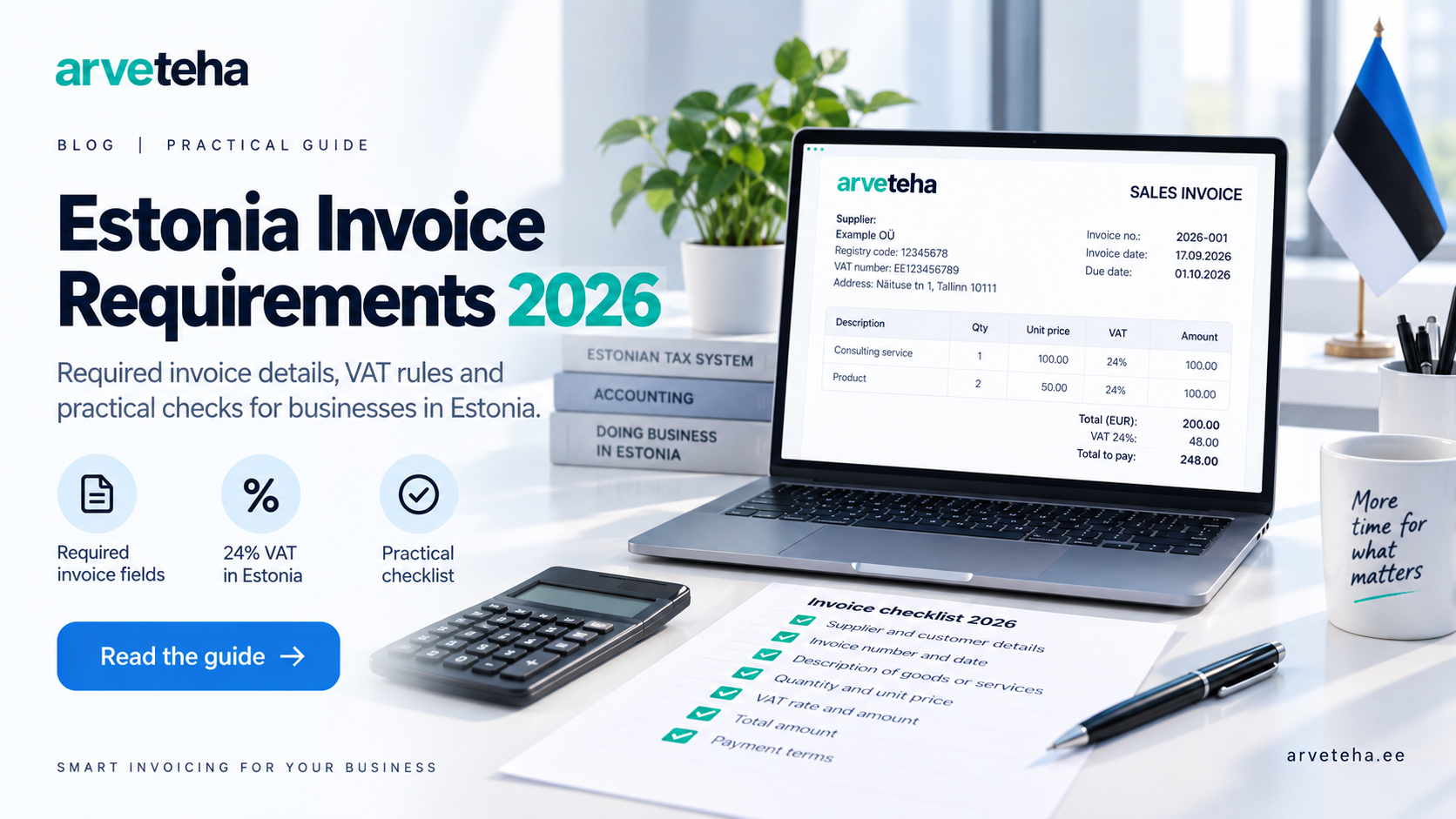
- Use a unique, traceable invoice serial number and include the date of issue.
- Show the seller’s name, address and VAT registration number when the seller is VAT-registered.
- Show the customer’s name and address, and the customer’s VAT registration number where the VAT Act requires it.
- Describe the goods or services clearly and state the quantity or extent supplied.
- Include the supply date or advance-payment date if it can be determined and differs from the invoice date.
- Show the price excluding VAT, relevant discounts, the taxable amount by VAT rate, the applicable rate and the VAT payable in euros.
Required VAT invoice fields under § 37
The Estonian Tax and Customs Board (MTA) summarises the mandatory VAT invoice information from § 37(7) of the Value-Added Tax Act. The exact requirement can depend on the transaction, but the standard list is as follows.
| Required field | What to include | Practical note |
|---|---|---|
| Serial number and issue date | A unique invoice number and the date the invoice is issued | Use consistent numbering so invoices are easy to trace. |
| Seller details | Seller name, address and VAT registration number | For an Estonian VAT-registered business, use the correct EE VAT number. |
| Customer details | Customer name and address | Include the customer’s VAT number when the VAT Act requires it, especially in relevant cross-border cases. |
| Goods or services | Name or clear description | Avoid vague wording that does not identify what was supplied. |
| Quantity or extent | Quantity of goods or scope of services | For services, the extent can be expressed by hours, period, project stage or another meaningful measure. |
| Supply / advance-payment date | Date of dispatch, supply or receipt of full/partial payment when it differs from the invoice date | Include it when the date can be determined and is different from the issue date. |
| Price excluding VAT | Net price and discounts not already included in the price | Keep the calculation transparent. |
| Taxable amount and VAT rate | Taxable amount broken down by each VAT rate and the applicable rate | Separate 24%, reduced, 0% or exempt amounts where relevant. |
| VAT payable | Amount of VAT payable, normally stated in euros | There are statutory exceptions where VAT is not shown in the usual way. |
Required by VAT law vs recommended in practice
Businesses often add information that is useful for payment and bookkeeping even though it is not part of the core list in § 37(7). The distinction matters: a field can be commercially useful without being a statutory VAT-invoice requirement.
| Field | Required by VAT Act § 37(7)? | Recommended in practice |
|---|---|---|
| Invoice number | Yes | Yes — use a consistent numbering sequence. |
| Issue date | Yes | Yes. |
| Seller and customer details | Yes, as applicable | Yes — use registry data consistently. |
| VAT registration numbers | Yes, where applicable | Yes — verify them for relevant VAT transactions. |
| Description, quantity/extent, prices and VAT | Yes | Yes — keep the breakdown clear. |
| IBAN / bank account | Not in the core § 37(7) list | Usually useful if the customer should pay by bank transfer. |
| Payment term / due date | Not in the core § 37(7) list | Strongly recommended for commercial clarity. |
| Reference number | Not in the core § 37(7) list | Useful for automated payment matching. |
| Signature | No general VAT-invoice signature requirement | Usually unnecessary unless another agreement or process requires it. |
VAT rates in Estonia in 2026
Estonia’s standard VAT rate is 24% from 1 July 2025. Reduced rates of 13% and 9%, a 0% rate and VAT exemptions apply only where the Value-Added Tax Act provides for them.
When must an invoice be issued in Estonia?
For a taxable person, the general rule is to issue an invoice within seven calendar days from the date the goods are dispatched or made available to the customer, or the services are provided. If the supply arises when full or partial payment is received, the invoice is generally due within seven calendar days from receipt of that payment.
There are special timing rules for some intra-Community supplies and services. For certain transactions, the invoice may be issued by the 15th day of the following calendar month. That is why cross-border transactions should not be handled by applying the domestic seven-day rule automatically.
Simplified invoices: a narrow exception
The VAT Act allows simplified invoices in specific situations, such as certain passenger transport services, parking meters, automated petrol stations and similar machines. MTA states that simplified invoices may be used when the amount invoiced does not exceed €160 excluding VAT.
A normal shop receipt is not automatically a simplified VAT invoice. MTA specifically notes that a standard retail receipt or a receipt from a staffed petrol station does not become a simplified invoice merely because it contains VAT information.
- date of issue;
- name and VAT registration number of the taxable seller;
- name or description of the goods or services;
- taxable amount and VAT payable.
Cross-border, zero-rated and reverse-charge invoices
Cross-border invoices can require additional information. For example, MTA highlights the importance of the customer’s valid VAT registration number for intra-Community supplies of goods. Special wording may also be required for reverse charge, self-billing, exemptions or other specific VAT treatments.
For intra-Community supplies, exports or services taxed outside Estonia, do not rely on a generic domestic invoice template without checking the VAT treatment. The correct wording and VAT number requirements depend on the transaction.
Is a PDF invoice valid in Estonia? What about an electronic invoice?
Yes. MTA states that an invoice may be issued on paper or, subject to acceptance by the customer, electronically. A PDF can therefore be a valid electronic invoice document when the required invoice information is present.
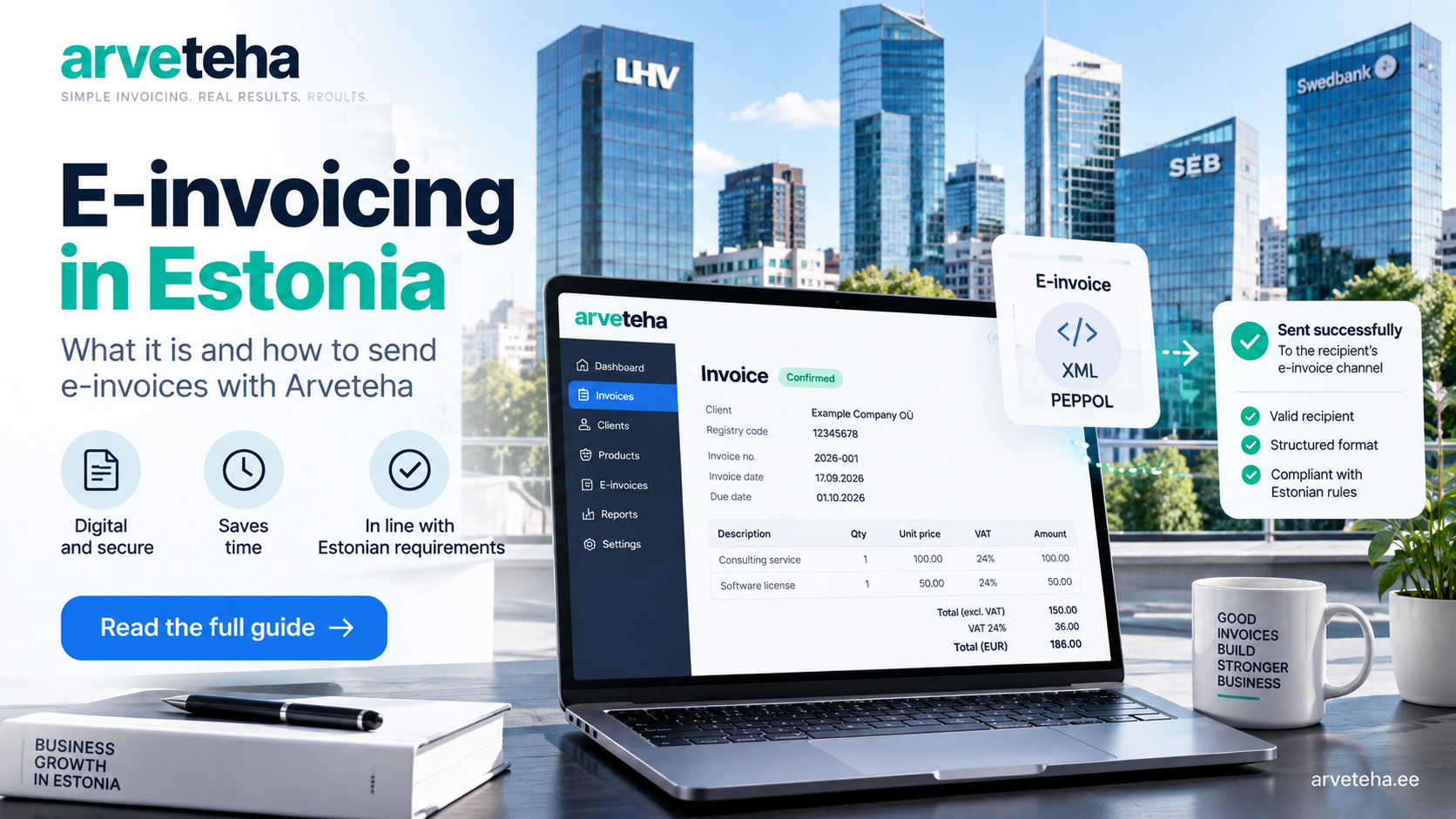
However, a PDF is not the same as a structured e-invoice. A structured e-invoice contains machine-readable invoice data that accounting systems can process automatically. The distinction matters when a customer is entitled to require an e-invoice rather than a PDF.
When can a customer require an e-invoice?
From 1 July 2025, an accounting entity registered in the Estonian Commercial Register as an e-invoice recipient may require the seller to submit an e-invoice for purchased goods or services. Under the Accounting Act, an e-invoice is presumed compliant if it follows the European e-invoicing standard EN 16931-1, unless the parties agree on another relevant standard.
Practical 2026 invoice checklist for Estonia
- Confirm who is issuing the invoice and whether the seller is VAT-registered.
- Use a unique invoice number and the correct issue date.
- Enter the seller and customer details accurately.
- Describe the goods or services clearly and state quantity or extent.
- Add the supply or advance-payment date when required and different from the issue date.
- Use the correct VAT treatment for the transaction — do not assume 24% applies to every supply.
- Show net amounts, taxable amounts by rate and VAT payable in euros where required.
- Add practical payment information such as due date, IBAN and reference number when useful.
- For cross-border, reverse-charge or exempt transactions, check whether additional wording is required.
- Choose the delivery format the customer needs: PDF, XML or structured e-invoice.
If you want a faster workflow, use the Invoice Generator Estonia guide to see how the required invoice information fits into an online invoicing process in Arveteha.
Frequently asked questions
Is an IBAN mandatory on an Estonian VAT invoice?
No. An IBAN is not part of the core mandatory information listed in § 37(7) of the Value-Added Tax Act. It is still useful when you expect the customer to pay by bank transfer.
Is a payment due date mandatory on an invoice in Estonia?
A payment term or due date is not part of the core mandatory VAT-invoice list in § 37(7), but it is strongly recommended because it makes the payment obligation clear to the customer.
Does an Estonian invoice need a signature?
There is no general VAT-invoice requirement for a signature. MTA also notes that a signature is not a mandatory invoice feature in the context of self-billing. A contract or internal procedure may still require approval in a particular case.
Is a PDF invoice valid in Estonia?
Yes, provided the invoice contains the information required for the transaction. MTA states that an invoice may be issued on paper or electronically with the customer’s acceptance. A PDF is not, however, the same as a structured e-invoice.
What is the standard VAT rate in Estonia in 2026?
The standard VAT rate is 24%. It has applied from 1 July 2025. Reduced rates, zero rating and exemptions apply only when the law provides for them.
How quickly must an invoice be issued in Estonia?
For taxable persons, the general rule is seven calendar days from the relevant supply event. Special rules apply to some advance payments, long-term or regular supplies and intra-Community transactions.
Can a customer require an e-invoice in Estonia?
Yes, in certain cases. From 1 July 2025, an accounting entity marked in the Commercial Register as an e-invoice recipient may require the seller to submit an e-invoice for purchased goods or services.
Official sources
- Estonian Tax and Customs Board — Information included on invoices
- Estonian Tax and Customs Board — Issuance of invoices
- Estonian Tax and Customs Board — Issuance of simplified invoices
- Estonian Tax and Customs Board — Standard VAT rate
- Riigi Teataja — Accounting Act § 7¹ (e-invoice recipient right)
Invoice and VAT requirements depend on the transaction. For unusual, exempt or cross-border cases, check the official source or obtain professional advice.