Quick answer: what an Estonia invoice generator should handle
- Estonia’s standard VAT rate is 24% from 1 July 2025.
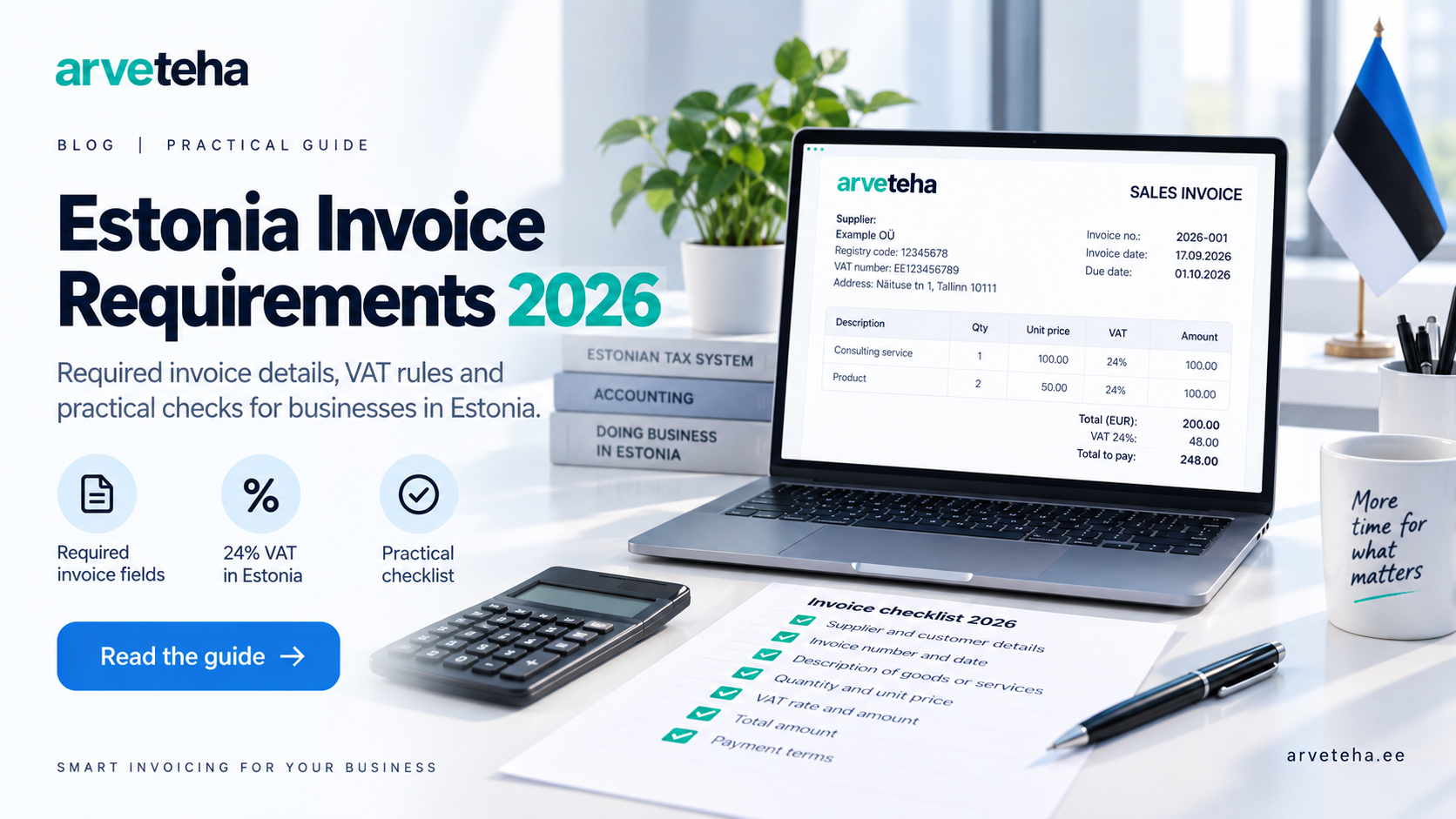
- A VAT invoice has specific data requirements under § 37 of the Estonian Value-Added Tax Act.
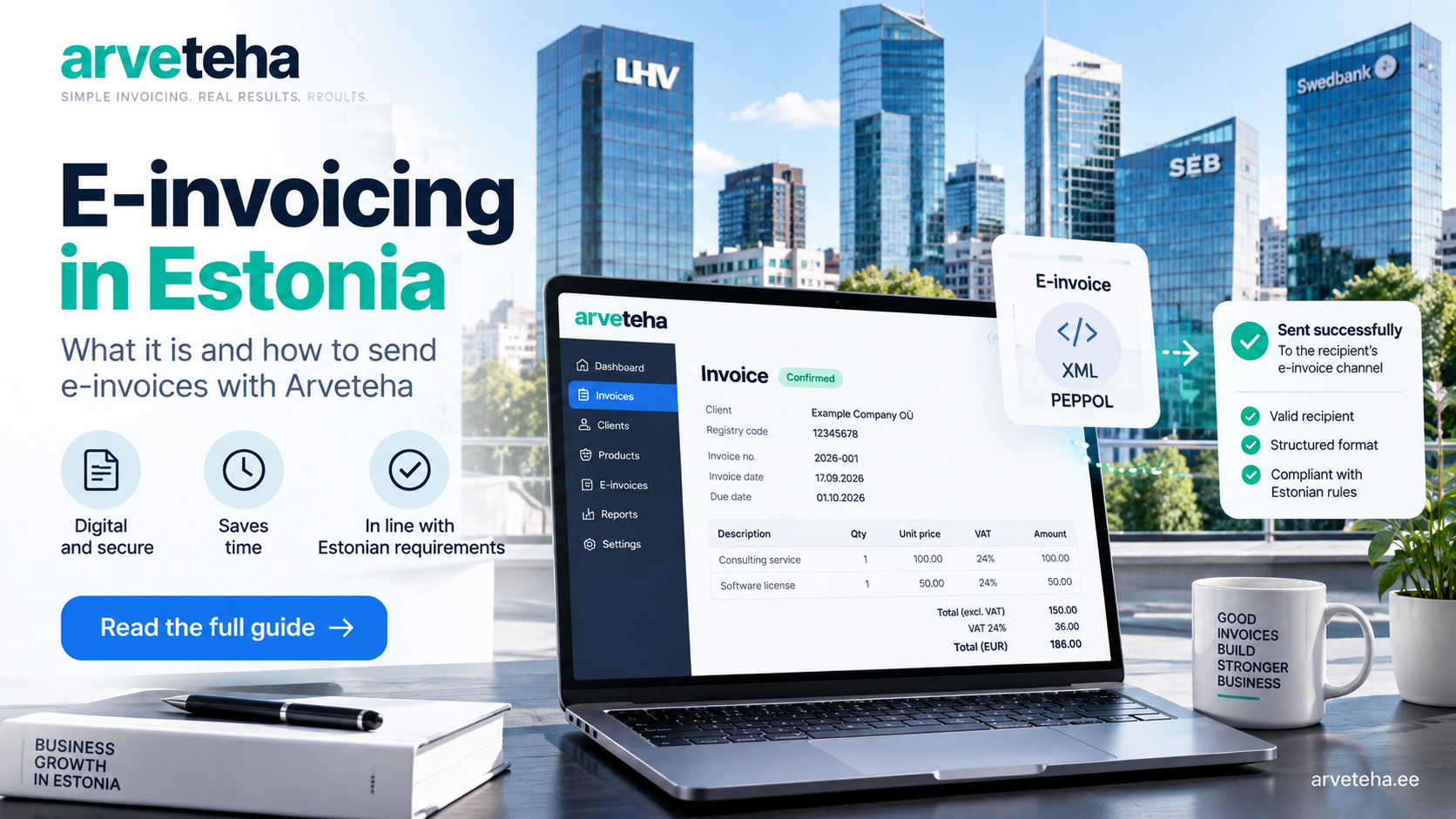
- A PDF invoice is not the same as an e-invoice: a true e-invoice is machine-readable and can move directly between systems.
What is an invoice generator?
An invoice generator is an online tool for creating a structured sales invoice from reusable business, customer and product/service data. For a business in Estonia, the useful part is not just the final document — it is the repeatable workflow behind it.
A basic one-off generator may be enough if you send a single invoice. A business that invoices every week usually needs more: invoice numbering, customer records, products or services, payment terms, VAT handling, PDF export and a history of issued invoices.
What should good invoice software in Estonia do?
- Keep your company details, registry code, VAT number and bank details ready for reuse.
- Save clients and products/services so the next invoice takes less time.
- Support the VAT rates relevant to the transaction, including the current 24% standard rate.
- Create a professional PDF and, when needed, machine-readable XML.
- Keep invoice numbers and dates consistent.
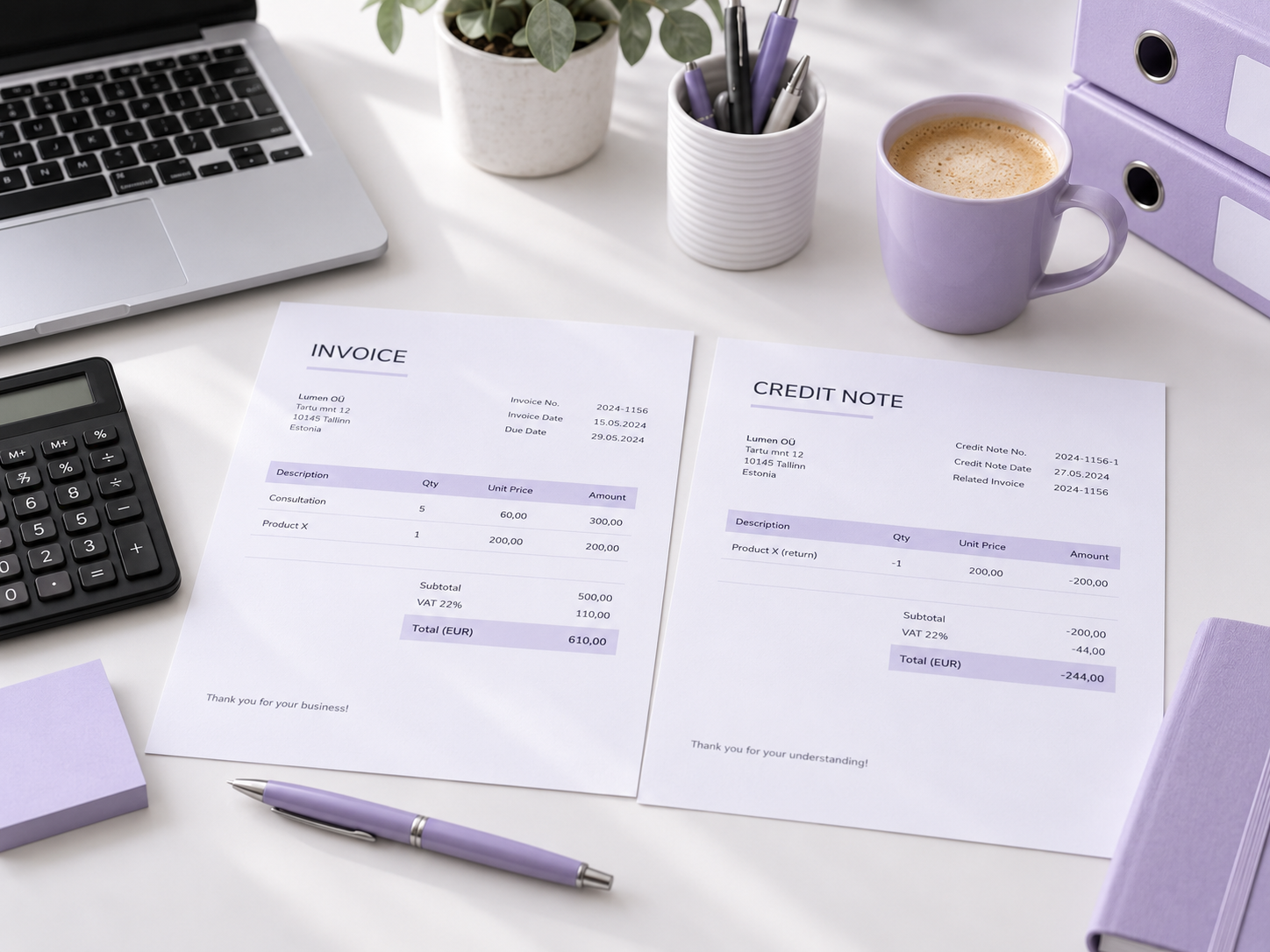
- Show totals clearly in EUR and separate net amount, VAT and gross total.
- Support e-invoice sending as a separate workflow instead of calling a PDF an e-invoice.
Word, Excel or invoice software?
| Method | Works for | Main limitation |
|---|---|---|
| Word / document template | Very occasional invoices | You retype data and control numbering manually. |
| Excel / spreadsheet | Simple calculations and a small number of invoices | Easy to break formulas, duplicate numbers or lose a clear invoice history. |
| Online invoice generator | Regular invoicing by a small business | Better structure and reuse, but check whether Estonia-specific VAT and invoice fields are supported. |
| Arveteha | OÜ, FIE and service businesses in Estonia | Designed around the local invoicing workflow with clients, products, invoices, PDF/XML and e-invoice sending in Business PRO. |
How to create an invoice in Arveteha
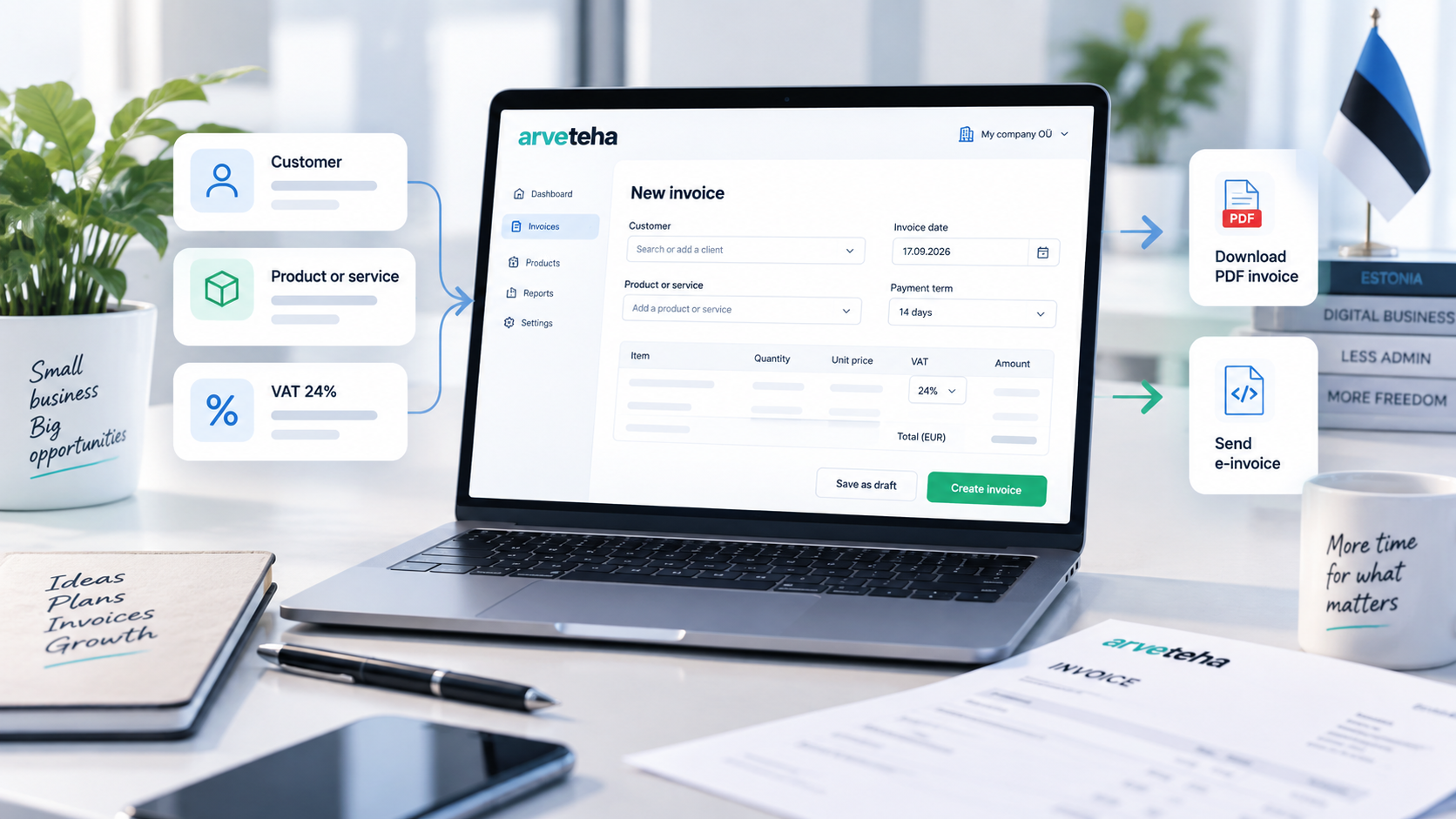
- Choose the company you are invoicing from and create or select the customer.
- Add the product or service, quantity, unit price and the VAT treatment that applies to the transaction.
- Check the invoice date, payment term, invoice number and totals.
- Save the invoice as a draft or confirm it when the details are final.
- Download the PDF/XML or, if you use Business PRO and the recipient can receive it, send the invoice as an e-invoice.
Is it suitable for an OÜ or FIE?
Yes. An Estonian OÜ normally invoices using the company’s legal name, registry code and, if VAT-registered, VAT number. An FIE invoices under the registered business name/details that identify the entrepreneur. The customer, service description, amounts and dates still need to describe the actual transaction.
The same workflow is useful for consultants, construction and service companies, freelancers operating through an Estonian business, and small companies that do not want a full accounting suite just to issue sales invoices.
VAT and invoice requirements in Estonia
From 1 July 2025, Estonia’s standard VAT rate is 24%. Reduced or zero rates and exemptions apply only where the law provides for them, so the correct VAT treatment depends on the actual supply.
For VAT invoices, § 37 of the Estonian Value-Added Tax Act sets out the information that needs to appear on the invoice. The MTA guidance lists items such as the invoice serial number and issue date, seller details and VAT number, buyer details where required, the goods or services, quantity or extent, relevant supply/payment date, taxable amount, rate and VAT payable.
| Invoice data | Why it matters |
|---|---|
| Invoice number + issue date | Identifies the invoice and its place in the invoice sequence. |
| Seller details | Identifies the business issuing the invoice. |
| Buyer details | Identifies who acquired the goods or services. |
| Goods or services | Explains what was supplied. |
| Quantity / extent and price | Shows how the amount was calculated. |
| VAT treatment | Shows the applicable rate/tax basis when VAT rules require it. |
| Total payable | Gives the customer the final amount due. |
PDF, XML and e-invoice are different things
A PDF is mainly a human-readable document. XML is a structured machine-readable format. An e-invoice is structured invoice data delivered through an electronic invoicing workflow so the recipient’s system can process it.
That distinction matters in Estonia because simply attaching a PDF to an email does not turn it into an e-invoice, and exporting XML is not the same as directly sending an e-invoice to a recipient.
Free invoice generator or Business PRO?
If you only need to create and manage normal invoices, the free Arveteha Starter workflow covers the core invoicing process. Business PRO is for businesses that also need the paid functionality around direct e-invoice sending and the expanded service flow.
The practical choice is simple: start with the invoicing workflow you actually need, then move to PRO only when the extra functionality saves you time or becomes necessary for customers who expect e-invoices.
Quick decision checklist
- Does the tool support Estonia’s current VAT rates instead of outdated 20% or 22% defaults?
- Can you store OÜ/FIE company details, customers and products/services?
- Does it maintain invoice numbering and dates consistently?
- Can you create PDF and machine-readable output without retyping the invoice?
- Does it clearly distinguish PDF, XML and direct e-invoice sending?
- Can you start without installing desktop software?
- Are the product features described exactly as they work today?
Frequently asked questions
Can I create an invoice online in Estonia without installing software?
Yes. A browser-based invoice generator such as Arveteha lets you create and manage invoices online without installing a desktop program.
What is the standard VAT rate in Estonia in 2026?
The standard VAT rate is 24%. It has applied from 1 July 2025. Reduced rates, zero rating and exemptions apply only where the law provides for them.
Can an OÜ use Arveteha?
Yes. Arveteha is designed for Estonian businesses, including OÜ companies, and stores company, customer, product/service and invoice data in one workspace.
Can an FIE use an invoice generator?
Yes. An FIE can use an invoice generator to create invoices using the registered business details that identify the entrepreneur and the actual transaction.
Is a PDF invoice an e-invoice?
No. A PDF is a human-readable electronic document. An e-invoice is structured machine-readable invoice data delivered through an e-invoicing workflow.
Can Arveteha send e-invoices?
Direct e-invoice sending is available through Arveteha Business PRO when the service is active and the recipient is able to receive an e-invoice.
Do I need to install Arveteha?
No. Arveteha is used in the browser.
Official sources
- Estonian Tax and Customs Board — Standard VAT rate
- Estonian Tax and Customs Board — Information included on invoices
- Estonian Tax and Customs Board — Issuance of invoices
- Riigi Teataja — Value-Added Tax Act § 37
Tax and invoicing rules can depend on the transaction. For unusual or cross-border cases, check the official source or obtain professional advice.