
The real-time economy is not about economic cycles
The economy has always moved in cycles. Growth gives way to slowdowns; prices, wages and demand move up and down. That is not what policymakers mean when they talk about the real-time economy (RTE).
The term describes something more practical: information about economic activity moving between companies, software and public authorities with much less delay and manual handling.
Consider the familiar journey of an invoice. A supplier provides goods or services and issues an invoice. Someone at the customer’s business records it, an accountant checks the entries, and figures eventually find their way into a tax return. Some of the same information may be entered more than once, in different systems and at different times.
Real-time economy initiatives aim to reduce this repeated manual data entry through the use of structured, machine-readable information. An invoice can be imported directly into compatible accounting software; transaction data required by law can be reported electronically; and errors can be identified earlier.
That can be useful. It does not, however, tell us whether a business will pay less for accounting, whether an accountant will earn more or less, or whether a new software subscription will offset some of the savings. Those are economic questions, not merely technical ones.
Why the EU wants a faster view of cross-border trade
On 11 March 2025, the Council of the European Union adopted the VAT in the Digital Age (ViDA) package. One of its central reforms is digital reporting for certain cross-border business-to-business transactions, built around structured electronic invoices.
Tax authorities currently depend on several forms of periodic reporting and information exchange. This can create a substantial delay between a transaction taking place and tax authorities in different countries receiving comparable information about it.
The longer the delay, the harder it can be to identify inconsistencies in a chain of transactions — particularly when a business involved has already disappeared.
Under ViDA, covered cross-border transactions will be reported electronically much closer to the time they occur. Tax authorities will receive more detailed, standardised information, making it easier to compare reports.
There is an important limit to this ambition. Digital transaction reporting is not the same thing as granting the authorities unrestricted access to a company's accounting system, bank accounts or every invoice. The scope, content and timing of reporting are set by law.
A German supplier and an Estonian customer
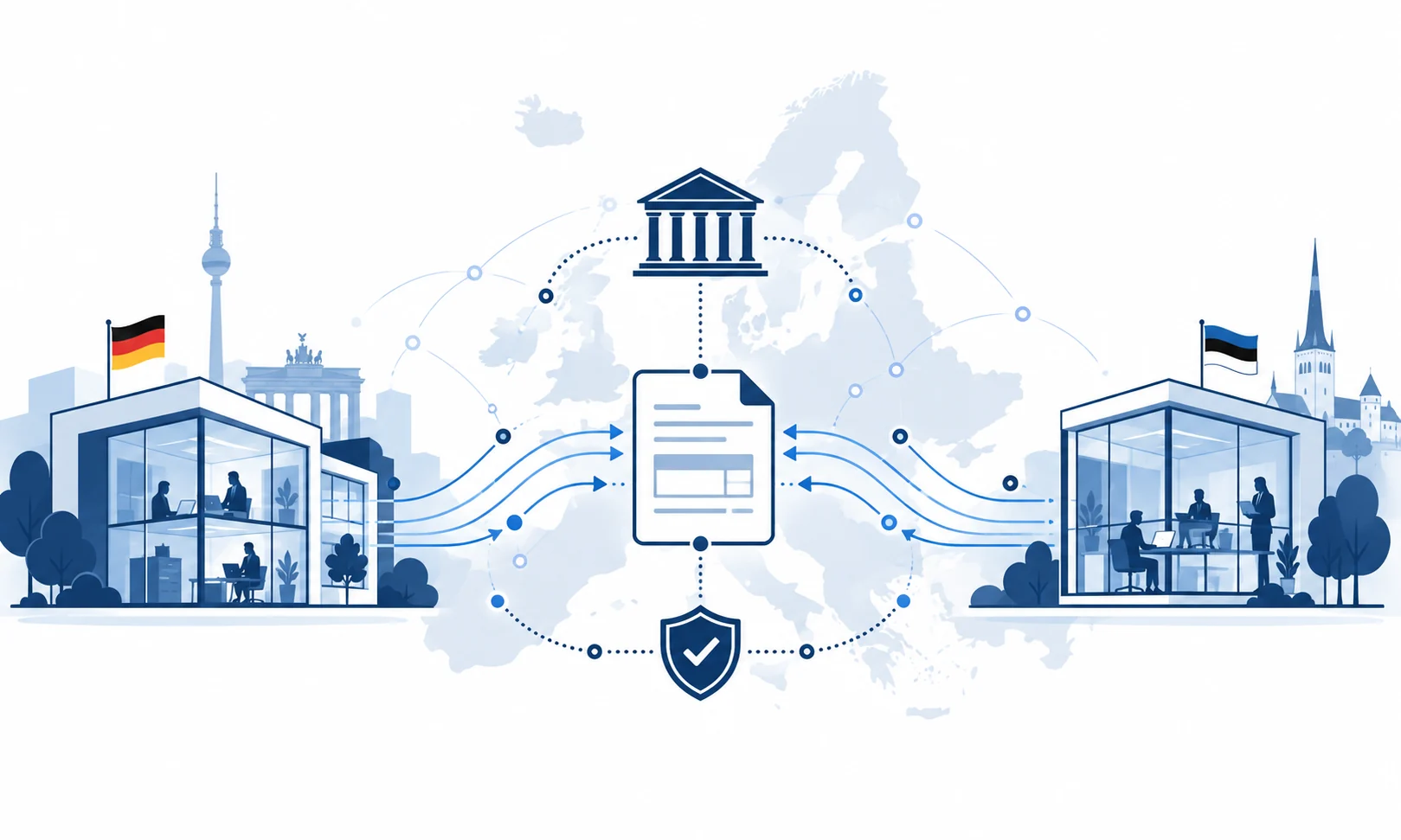
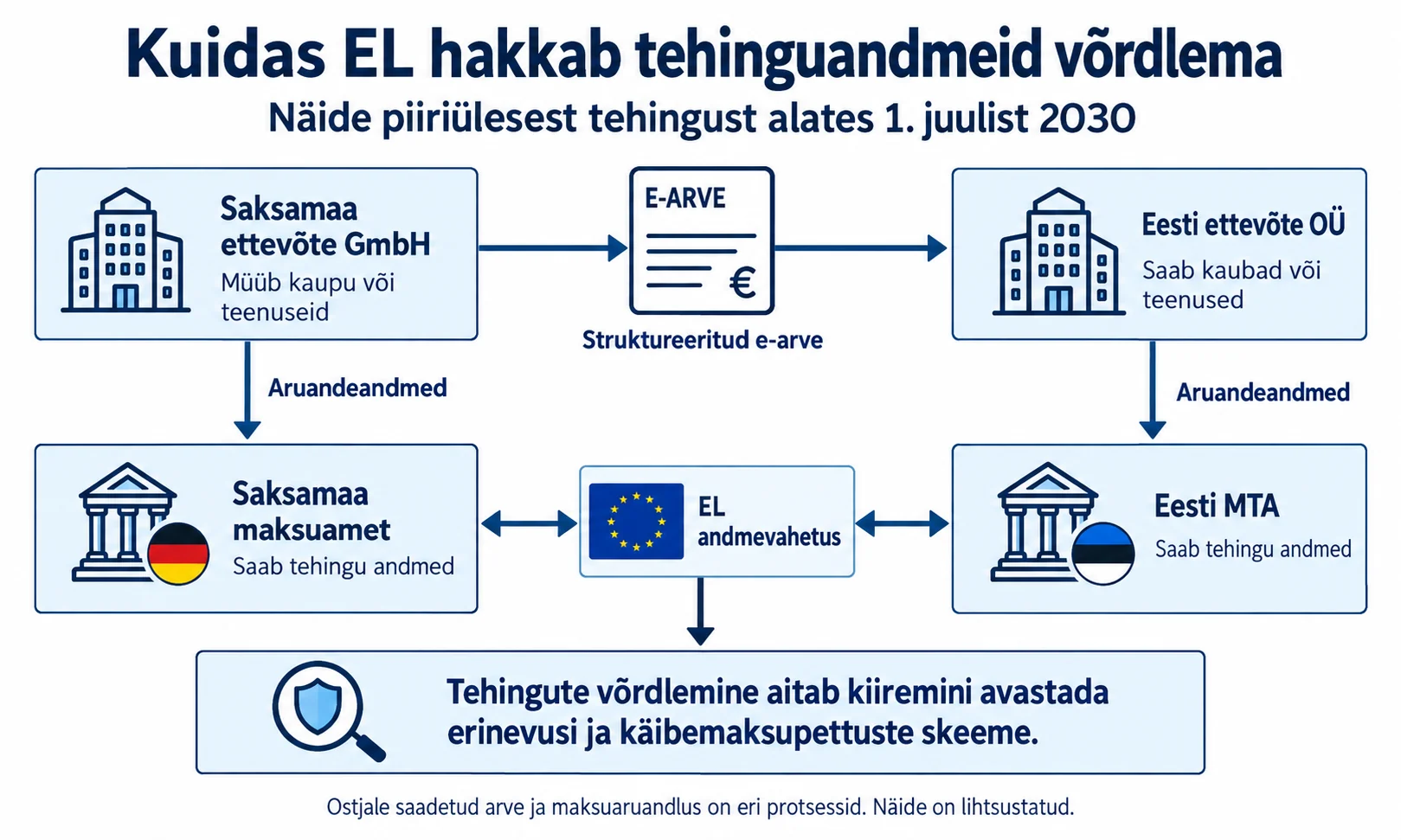
Imagine a German GmbH selling equipment worth €10,000 to an Estonian OÜ.
The German supplier issues a structured e-invoice. Unlike an image or PDF of a paper invoice, the structured e-invoice contains data that the Estonian customer's compatible accounting software can read directly, including supplier and customer details, the invoice number and the amounts charged.
That is one process — the exchange of an invoice between businesses.
Tax reporting is another. From 1 July 2030, the EU's new digital reporting requirements will apply to the cross-border B2B transactions covered by the ViDA rules. Relevant transaction data will be supplied to tax administrations, which will be able to exchange and compare information under the EU framework.
The German tax authority can use the seller's report, while the Estonian Tax and Customs Board (MTA) can use relevant buyer-side information where such reporting applies. If one side shows a €10,000 transaction and the other reports inconsistent information, the difference can be detected earlier.
A mismatch is not automatically evidence of wrongdoing. Corrections, accounting mistakes, reporting dates and legitimate tax treatments can all produce discrepancies. The advantage is that discrepancies can be investigated sooner, while the information is still relatively fresh.
The fraud problem behind the reform
The European Commission is explicit about one of the principal reasons for the changes: combating VAT fraud, particularly missing-trader or carousel fraud.
The basic mechanism exploits the different VAT treatment of cross-border and domestic transactions in the EU.
In a simplified example, a trader acquires goods from another member state under the applicable intra-EU VAT rules. It then resells those goods domestically and charges VAT to its customer. Instead of paying the VAT it collected to the tax authority, the trader disappears or ceases trading.
More elaborate arrangements use a network of businesses and repeated sales, sometimes moving the same goods across borders several times. Other participants may seek input VAT deductions or refunds even though VAT due earlier in the chain has not been paid.
Such schemes can inflict substantial losses on public revenue. They are difficult to investigate when the relevant records arrive separately, weeks after the transactions occurred.
Faster, transaction-based reporting gives tax authorities a better chance to spot contradictory records or suspicious patterns before the evidence becomes harder to follow.
The European Commission estimates that the digital reporting and e-invoicing measures could reduce VAT fraud by up to €11 billion per year. That is an expected benefit of the reform, not money already recovered.
The distinction matters. The purpose is not just to replace paper with digital files. Faster and more comparable information is itself an instrument of tax administration.
The EU timetable: 2025, 2028, 2030 and 2035
ViDA will not arrive everywhere overnight.
14 April 2025: EU Member States gained broader scope to require e-invoicing under specified conditions.
1 July 2028: Important VAT measures begin for certain digital platforms, including short-term accommodation and road passenger transport. Parts of the single VAT registration reforms also take effect.
1 July 2030: The core digital reporting requirements take effect for the cross-border B2B transactions covered by the new EU rules, using electronic invoicing as their basis.
1 January 2035: Existing domestic real-time transaction reporting systems covered by the transition arrangements must be aligned with the EU framework.
These dates do not mean that every transaction in every member state will automatically become visible to every tax authority. The new obligations apply to defined cases, and national arrangements still matter.
Nevertheless, the direction is clear: Europe is moving away from relying primarily on delayed, aggregated information and towards much faster reporting of relevant individual transactions.
Estonia has been developing its real-time economy for years

In Estonia, this approach is known as reaalajamajandus. In October 2020, the Ministry of Economic Affairs and Communications approved a vision for 2021–2027 aimed at replacing unnecessary, repetitive reporting with data-based information exchange.
The objective is broader than e-invoicing. It covers machine-readable business documents, automated reporting and the flow of information between business systems and public bodies.
Estonia has already begun changing its tax reporting processes. On 1 October 2026, the rules and formats for submitting payroll data in TSD annexes 1 and 2 changed as part of the move towards data-based reporting.
The next major step is the reform of VAT reporting through the KMD (VAT return).
E-invoices in Estonia: what has already changed?
Since 1 July 2025, Estonia has applied an expanded buyer chooses principle to e-invoicing.
An entity required to keep accounts that is publicly registered in the Estonian e-Business Register as an e-invoice recipient can require its supplier to issue a structured e-invoice, unless the parties have agreed otherwise.
This does not mean that every Estonian business must use e-invoices for every transaction. Other invoice formats remain possible within the applicable rules and agreements.
Nor does attaching a PDF make an invoice a structured e-invoice. A PDF is usually designed for someone to read. A structured e-invoice contains fields that suitable software can process directly.
For a company receiving many supplier invoices, that can reduce repeated entry of names, reference numbers, tax amounts and totals. An accountant still needs to check that the invoice is accurate and that the transaction has been recorded and taxed correctly.
Receiving an e-invoice does not, by itself, send the entire invoice to MTA. The supplier-to-customer invoice flow and statutory tax reporting are separate processes.
What Estonia plans for VAT reporting in April 2027
The Estonian Tax and Customs Board plans to introduce data-based KMD reporting from April 2027.
Rather than completing the entire return manually, a company will be able to send the transaction and accounting data needed to prepare it directly from compatible business software. MTA will use that data to calculate the VAT return.
The business owner or accountant can then review the resulting return, inspect the details and any errors flagged, and confirm it using PIN2. The arrangements involve standardised machine-readable formats, including XML based on XBRL GL; MTA also envisages submissions from more than one business system.
An important safeguard appears in MTA's published explanation: the business owner or accountant initiates the data transfer and decides when to submit it. MTA does not gain direct access to the company's accounting program simply because the new reporting method exists.
Reporting still concerns the information required for tax purposes. The existing limitations on detailed invoice reporting — including the applicable rules for smaller invoices and invoices issued to private individuals — remain relevant.
This changes how returns are prepared and submitted; it does not give the authorities continuous access to every entry in a company's accounts.
Four million hours of potential savings — but for whom?
MTA's material on data-based reporting projects a saving of at least four million working hours for Estonia's business sector, based in part on current use of the e-MTA environment and the manual work that automation could remove.
It is an estimate of future benefits across the reporting development programme, not an already measured saving from the 2027 KMD reform alone.
Four million hours sounds transformative. But to understand what it means for a business, we need to ask who currently spends those hours.
Official descriptions can make it sound as though the business owner personally enters data, prepares tax returns and handles every administrative task.
Sometimes that is true, especially for a one-person business. Often it is not.
Not every small company is a one-person business
Take a construction company employing ten people. The owner or manager finds customers, negotiates contracts, plans jobs, purchases materials and oversees delivery. Skilled employees carry out the work.
Invoices, payroll, VAT calculations and monthly reporting may be handled by an in-house accountant or an external accounting practice.
The owner is not necessarily the person spending hours each month entering figures into e-MTA. That is a task already delegated to a specialist.
If new software automates part of the filing process, it can genuinely remove manual work. But it may be the accountant, rather than the owner, who saves the time.
The owner might benefit through lower accounting fees, fewer errors or faster access to figures. Yet none of those benefits is guaranteed simply because part of the process has been automated.
If the company pays a fixed monthly accounting fee, the same bill may arrive even when the accountant completes the work faster. An accounting firm might instead use the extra capacity to serve more clients. Or the business might face a higher software bill to support a new reporting interface.
Does automation threaten accountants' income?
Automation changes accounting work, but it does not make sound accounting judgement unnecessary.
Routine data entry, transfers between systems and the preparation of standard reports are increasingly handled by software. Accountants can use the time freed up by automation to check transactions, interpret tax rules, reconcile accounts, advise clients and analyse financial performance.
That shift also has economic consequences. An accountancy firm that relies heavily on document processing may find that clients are less willing to pay for routine tasks. Some accountants may be able to serve more clients in the same number of working hours; others may face pressure to offer different services.
Software can transmit an incorrect figure with exceptional speed. It cannot make that figure correct merely by delivering it electronically. Someone still has to understand what the transaction represents, determine the proper treatment and resolve discrepancies.
The likely change is therefore not a world without accountants, but a shift in which parts of accounting create paid value.
Where does the financial benefit go?
Digital reporting can create gains for several parties, but those gains do not automatically reach everyone equally.
Tax authorities receive information earlier and can identify mismatches more efficiently.
Accountants may spend less time on repetitive administrative tasks and more time on work that requires professional judgement.
Software providers have opportunities to develop and sell integrations, reporting services and compliance features.
Businesses may benefit from faster processes, improved data quality and lower administrative costs.
Yet developing software, maintaining secure interfaces and keeping up with regulatory changes all come at a cost. Some of the savings from manual work may be absorbed by new or higher subscription fees.
Likewise, higher productivity in an accounting practice might lower prices, support better service or increase the practice's margin. The outcome depends on competition, contracts and business decisions, not on technology alone.
That is why reducing the labour required for a task is not the same as reducing what a small company pays for the task.
How should we judge whether the reform worked?
A successful reform should be measured by more than the number of messages transmitted or working hours theoretically saved.
For a small company, useful questions are concrete. What did accounting and reporting cost before the change? What will they cost afterwards, including software? How many procedures were genuinely removed? Did correcting mistakes become easier? Does the manager get reliable information sooner? Are there fewer unnecessary interactions with government systems?
Better tax enforcement is a legitimate public benefit. Easier accounting is also a legitimate business benefit. They should not, however, be treated as if one automatically proves the other.
Technology can make information travel faster. Whether it makes business more affordable must be demonstrated separately.
Less administrative burden — but for whom?
The EU's ViDA reforms and Estonia's real-time economy initiatives pursue important goals: more reliable records, less duplicate data entry and faster detection of VAT fraud. They can make a genuine difference.
But when authorities speak about millions of hours being given back to entrepreneurs, there is one final question worth asking:
If accountants still prepare, verify and submit the information needed for tax reporting, how exactly will these innovations save the business owner's own time?
Not every small business is a one-person operation in which the owner handles sales, day-to-day work and the accounts.
And if it is mainly accountants who save time, will the company's accounting bill actually fall? Or will the same obligation simply be fulfilled through a newer system, potentially with another software subscription attached?
These are not arguments against digitalisation. They are the questions that turn an impressive technical project into an accountable economic reform.
Official sources and further reading
- European Commission — VAT in the Digital Age (ViDA)
- European Commission — VAT carousel fraud
- Estonian Ministry of Economic Affairs and Communications — Real-Time Economy vision
- Estonian Ministry of Finance — E-invoices
- Estonian Tax and Customs Board (MTA) — Data-based reporting
- Estonian Tax and Customs Board (MTA) — KMD reporting changes in 2027
Sources and publication date: 13 October 2026. Future plans and estimates are not yet realised outcomes.

Leave a comment
Comments 0